



Why Response Time Matters in Lead Conversion
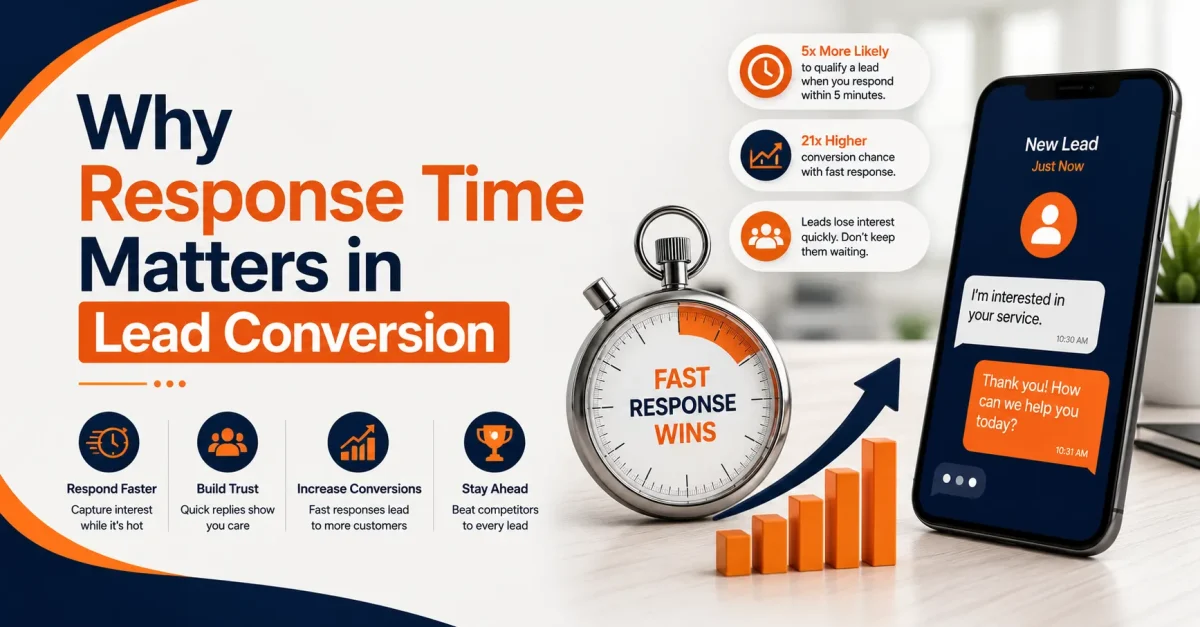

Table of Contents
Lead response time is one of the easiest sales problems to ignore until revenue starts leaking.
A lead fills out a form. Someone calls after lunch. A prospect requests pricing. The sales team follows up the next morning. Nothing feels broken, but the buyer has already moved on.
That is why fast response is not just a sales habit. It is a conversion advantage.
This guide explains why lead response time matters, where businesses lose opportunities, and how faster call handling, routing, and follow-up workflows can improve lead velocity.
Want fewer missed sales opportunities? Explore Vitel Global’s AI-powered unified communications platform to connect calling, messaging, meetings, follow-ups, and insights in one place.
What Is Lead Response Time?
Lead response time is the amount of time between a prospect showing interest and your business making the first meaningful response.
That interest may come from:
- A website form
- A phone call
- A demo request
- A pricing inquiry
- A live chat message
- A WhatsApp or SMS inquiry
- A missed call
- A referral handoff
- A campaign landing page
The first response does not always need to close the sale. But it should confirm interest, capture context, qualify the need, and move the buyer to the next step.
A fast response tells the prospect, “We saw your request, and we are ready to help.”
A slow response tells them something else, even if you did not mean it.
Why Does Response Time Matter So Much in Lead Conversion?
Response time matters because buyer intent is highest at the moment the lead reaches out.
That moment is fragile. The person has a need, a question, a problem, or an active buying trigger. If nobody responds quickly, the lead does not wait politely. They search again. They call another provider. They click another ad. Ultimately, the lead books with the company that answered first.
This is where many businesses misunderstand lead conversion. They spend money to generate leads, but they do not protect the moment after the lead arrives.
Research from the Lead Response Management study found that the odds of contacting a lead drop sharply when teams wait. The study reported that calling within 5 minutes versus 30 minutes produced a 100x difference in contact odds and a 21x difference in qualification odds.
That is the real lesson behind speed to lead. The first few minutes are not just “nice to have.” They are where conversion probability is still alive.
The Real Cost of Slow Lead Response
Slow lead response rarely shows up as one obvious loss. It appears in smaller ways across the sales process.
A missed call becomes a voicemail nobody checks fast enough.
A demo request waits in the CRM.
A sales rep sees the notification after another meeting.
A prospect compares three vendors and hears back from someone else first.
The cost usually shows up as:
- Lower sales conversion from paid campaigns
- Higher cost per lead because fewer leads convert
- More unqualified follow-ups because buyer intent has cooled
- More missed appointments and lost quote requests
- Lower trust when prospects feel ignored
- More pressure on sales teams to chase cold conversations
This is why improving sales response time is not only a sales team issue. It affects marketing ROI, customer experience, pipeline quality, and revenue predictability.
If a business pays for ads, SEO, landing pages, events, or referrals, slow response time can waste the value of that entire effort.
What Happens After the First 5 Minutes?
The first 5 minutes matter because the buyer still remembers why they reached out.
After that, the conversation gets harder.
The prospect may still answer, but now the sales team has to rebuild context. The buyer may ask, “Who is this?” or “I already spoke to someone else.” The urgency drops. The lead becomes less about solving the problem and more about re-opening attention.
That is where response delay becomes a missed opportunity.
The 5-minute lead response rule does not mean every business must close a deal in 5 minutes. It means the first contact should happen while the lead is still active.
A good first response can be simple:
- Confirm the inquiry
- Ask one qualifying question
- Route the lead to the right person
- Schedule the next step
- Send a relevant follow-up
- Log the conversation for the sales team
The mistake is waiting until the lead feels cold and then treating it like a normal follow-up.
Where Lead Response Usually Breaks Down
Most businesses do not lose leads because sales teams are lazy. They lose leads because the follow-up process has too many weak handoffs.
The lead comes in through one channel. The right person is busy. The notification goes to email. The CRM is updated later. The sales manager assumes someone called. The prospect gets a reply after the window has passed.
That is how lead velocity slows down.
| Lead Response Gap | What Usually Happens | Sales Impact |
| Missed inbound calls | Calls go to voicemail or wait for a callback | High-intent leads move to competitors |
| Slow form follow-up | Sales responds after hours or with delay | Buyer intent drops before contact |
| Poor routing | Leads reach the wrong person or department | Multiple transfers reduce trust |
| After-hours inquiries | No response until the next business day | Competitors capture ready-to-buy prospects |
| No follow-up record | Teams forget past conversations or commitments | Repeated questions and weak handoffs |
| Manual reminders | Reps depend on memory or spreadsheets | Follow-ups become inconsistent |
| No call insight | Managers lack visibility into lost opportunities | Process issues remain unresolved |
The issue is not just speed. It is the consistency.
A fast but messy response still creates friction. A good lead response process should be fast, routed correctly, documented clearly, and followed up without delay.
How Fast Should a Business Respond to a Lead?
Businesses should aim to respond to high-intent leads within 5 minutes or less.
For urgent channels such as phone calls, live chat, WhatsApp, and demo requests, the response should be as close to immediate as possible. For lower-intent leads, such as newsletter signups or downloaded resources, the response can be slower, but the workflow should still be structured.
A simple lead response priority model looks like this:
- Immediate: Phone calls, missed calls, pricing requests, demo forms, appointment requests
- Within 5 minutes: Website forms, chat inquiries, WhatsApp messages, quote requests
- Within 1 hour: Webinar inquiries, campaign replies, contact page submissions
- Same day: Content downloads, general inquiries, low-intent nurture leads
The key is to stop treating every lead the same way.
A buyer asking for a quote needs a faster response than someone downloading a guide. A missed call from a local customer needs faster action than a cold email reply. A demo request should not sit behind general inbox messages.
Why Speed Alone Is Not Enough
Speed matters, but speed without context can still damage conversion.
A prospect does not want a rushed, robotic callback. They want a helpful response from someone who understands why they reached out.
That means sales response time should include three things:
- Fast first contact
The lead should know the business received the request. - Accurate routing
The lead should reach the right person or team quickly. - Clear follow-up
The conversation should result in a next step, not just a missed note.
This is where many businesses confuse activity with progress. Calling quickly is good. Calling quickly with the right context is better.
How AI and Business Phone Systems Improve Lead Response Time
AI and modern business phone systems help teams respond faster by reducing the manual work between inquiry and action.
Vitel Global’s AI-powered unified communications platform connects calling, messaging, meetings, routing, follow-ups, and insights so teams can stay responsive across customer touchpoints. The platform is positioned around automating routing, responses, follow-ups, and insights across business communication workflows.
For lead conversion, that matters because speed to lead depends on what happens immediately after inquiry.
A modern communication setup can support:
- Faster inbound call handling
- Smart routing to the right team or extension
- Missed call visibility
- AI call summaries and transcripts
- Follow-up task creation
- CRM-connected lead records
- Call logs for manager review
- Messaging and callback workflows
- After-hours answering support
- Clearer handoffs between sales and support
Vitel Global’s AI call assistant content also highlights lead capture, faster call qualification, CRM integration, business messaging, and call workflow support as related use cases.
Slow callbacks can turn hot leads cold. See how Vitel Global’s AI Call Assistant helps teams capture call insights, action items, and follow-ups without losing context.
How to Improve Sales Response Time Without Overloading the Team
Improving sales response time does not always mean hiring more reps. Often, it means fixing the path between lead arrival and first action.
Start with these checks:
- Identify every lead source and who owns the first response.
- Set response-time targets by channel and lead intent.
- Route urgent leads to the right person automatically.
- Use call logs to spot missed calls and delayed callbacks.
- Create follow-up templates for common inquiry types.
- Connect phone activity with CRM records where possible.
- Review response-time performance weekly, not quarterly.
- Use AI summaries so reps do not lose call context.
- Set after-hours coverage for high-value lead channels.
- Track which leads convert after fast versus slow response.
The goal is not to make the process more complicated. The goal is to remove delay.
If your team has to manually check email, CRM, phone logs, chat messages, and spreadsheets to know who needs follow-up, the process is already too slow.
7 Signs Your Lead Response Process Is Too Manual
A manual follow-up process may work for a small team at first. But as lead volume grows, small delays become revenue leaks.
Your lead response process may be too manual if:
- Missed calls are checked only when someone has time.
- Website leads go to a shared inbox with no clear owner.
- Sales reps manually decide who should call each lead.
- Follow-up notes are stored across email, CRM, and chat.
- After-hours leads wait until the next working day.
- Managers cannot see where response delays happen.
- Prospects often say they already spoke to another provider.
These are not just process issues. They are conversion issues.
When lead response depends on memory, availability, and manual routing, the fastest competitor usually wins.
What a Better Lead Response Workflow Looks Like
A better lead response workflow should capture the lead, route it, respond quickly, document the interaction, and trigger the next step.
For example:
- A lead calls or submits a form.
- The system captures the inquiry.
- The lead is routed by intent, location, or team availability.
- The first response happens immediately or within minutes.
- The conversation is logged with notes, transcript, or summary.
- The next step is created as a task, message, or calendar action.
- Sales can follow up with context instead of starting cold.
This creates better lead velocity because the business is not just reacting faster. It is moving leads through the funnel with less friction.
For businesses already using HubSpot, Vitel Global’s HubSpot integration supports click-to-call, two-way contact sync, task automation, and follow-up workflows so teams can reduce missed lead activity.
How Vitel Global Helps Businesses Respond Faster
Vitel Global helps businesses improve lead response by bringing calling, messaging, routing, AI insights, and follow-up support into a connected communication environment.
That matters for businesses where leads arrive through phone calls, website forms, customer inquiries, support lines, appointment requests, and CRM workflows.
With Vitel Global, teams can support faster lead response through:
- Cloud calling for flexible team access
- Smart routing for quicker lead handling
- AI call summaries for better sales context
- Call transcripts for clearer records
- Call logs for tracking missed and completed calls
- CRM integration for follow-up visibility
- Omnichannel communication across calls and messages
- AI receptionist support for inbound lead capture
- AI call insights to review response quality and outcomes
Vitel Global’s call logs feature also helps businesses track inbound and outbound calls, call history, call outcomes, recordings, and reports for better customer interaction visibility.
The result is not just faster answering. It is a more reliable follow-up process.
Final Take
Lead response time matters because leads are most valuable when intent is fresh.
A slow response can turn a high-intent prospect into a cold follow-up. A missed call can waste ad spend. A delayed quote response can send a buyer to a competitor. The solution is not only telling sales teams to move faster. The real solution is building a response system that makes speed easier.
Businesses that want better sales conversion need faster first contact, smarter routing, cleaner follow-up records, and clearer visibility into where leads are lost.
That is where a connected communication platform like Vitel Global can help teams protect every lead conversation from the first ring to the next action.
Stop Losing Leads to Slow Response Time
Capture every inquiry, respond faster, and turn more prospects into qualified conversations with a connected communication system.
FAQs
1. What is lead response time?
Lead response time is the time between a prospect showing interest and a business making the first meaningful response. It may apply to calls, forms, chats, demo requests, missed calls, emails, or messaging inquiries.
2. Why is lead response time important?
Lead response time is important because buyer intent is highest when the prospect first reaches out. Faster responses improve the chance of making contact, qualifying the lead, and moving the buyer to the next step.
3. What is the 5 minute lead response rule?
The 5 minute lead response rule means businesses should try to contact high-intent leads within 5 minutes or less. Research shows contact and qualification odds drop sharply when teams wait longer.
4. How can businesses improve sales response time?
Businesses can improve sales response time by setting response targets, routing leads automatically, tracking missed calls, connecting phone activity with CRM records, using AI call summaries, and creating clear follow-up workflows.
5. How does Vitel Global help with lead response?
Vitel Global helps businesses respond faster with cloud calling, routing, call logs, AI call summaries, transcripts, CRM integrations, AI receptionist support, and connected communication workflows.
Published: July 13th, 2026
Subscribe to Our Latest Updates
Get monthly product and feature updates, the latest industry news, and more!