



Why Clinics Miss Calls After Office Hours
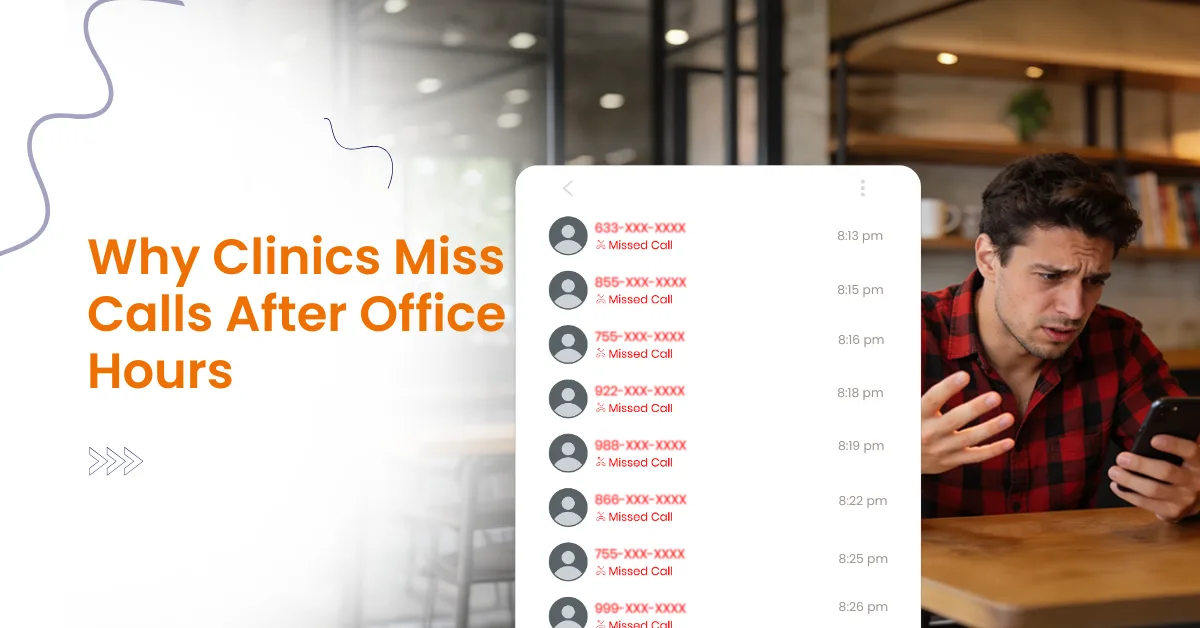

Table of Contents
Real Causes, Revenue Impact, Statistics, and the AI Receptionist Fix
Healthcare communication does not end at 5 PM.
Yet many primary care clinics, outpatient clinics, and internal medicine practices still operate as if it does.
At Vitel Global, we consistently see one hidden operational issue hurting medical practices: after-hours call loss.
Unanswered clinic calls create:
- Lost revenue
- Missed appointments
- Lower patient satisfaction
- Reduced clinic efficiency
- Increased emergency room visits
- Front desk overload
- Negative online reviews
- Long-term patient churn
This is not a small issue. It is a structural communication gap.
Are You Losing Revenue Every Evening?
If your clinic closes at 5 PM but patient calls continue until 9 PM, you may be losing appointments daily without realizing it.
Get a Free After-Hours Call Audit
This guide explains:
- Why do clinics experience after-hours appointment gaps
- The financial math behind missed patient communication
- Healthcare statistics and patient behavior data
- How automation fixes the issue permanently
Why Do Clinics Miss Calls After Office Hours?
Clinics miss after-hours calls because front desk coverage ends, evening call volume remains high, traditional answering services lack scheduling integration, and many healthcare providers do not use automated systems to manage patient communication outside business hours.
The result is measurable revenue leakage and patient frustration.
Top 7 Reasons Clinics Miss Calls After Office Hours
- Front desk staff leave at closing time.
- Evening call volume remains consistently high.
- Manual scheduling systems limit automation access.
- Traditional answering services lack integration.
- No secure messaging via patient portals.
- Limited online scheduling options for patients.
- High call volume exceeds staffing capacity.
This list format improves snippet eligibility and clarity.
Signs Your Clinic Is Losing After-Hours Calls
• Voicemail inbox fills overnight
• Staff return 10+ missed calls every morning
• Patients say “I tried calling last night”
• No after-hours scheduling confirmation
• Sudden no-show increases
If even two of these apply, your clinic has a communication gap.
What the Data Shows
Healthcare No-Show Rates
Industry studies indicate no-show rates typically range between 5% and 30%, depending on specialty and patient demographics.
Each missed appointment can cost $150–$300 or more.
After-Hours Call Behavior Trends
Patient behavior has changed.
Many patients contact clinics between 6 PM and 9 PM after work hours. When these incoming calls are unanswered, they often:
- Contact another provider
- Visit urgent care
- Go to the emergency room
- Delay care entirely
Delayed care reduces outcomes and retention.
Patient Communication Satisfaction
The Agency for Healthcare Research and Quality highlights communication quality as a major driver of patient satisfaction and care outcomes.
Patients consistently report higher satisfaction when clinics provide:
- Timely responses
- Digital scheduling options
- Clear communication
- Consistent follow-up
Preference for Digital Scheduling
Modern patients increasingly prefer:
- Online scheduling options
- Secure messaging access
- Immediate confirmation
- 24/7 appointment availability
Phone-only systems are becoming outdated.
Revenue Leakage Math: The Real Cost of Missed Calls
Let’s calculate the impact.
Assume:
- 15 missed patient calls per day
- 60% average conversion to appointments
- $200 average appointment revenue
15 × 60% = 9 lost appointments daily
9 × $200 = $1,800 daily revenue leakage
Monthly (20 working days):
$1,800 × 20 = $36,000
Annual impact:
$36,000 × 12 = $432,000
Even if your clinic loses half that, the revenue impact remains significant.
After-hours appointment gaps are not theoretical. They are measurable.
What Happens Inside the Clinic the Next Morning?
Morning reopening creates operational strain.
- Staff spend the first hour returning calls.
- Appointment systems require manual adjustments.
- Missed scheduled appointments increase no-shows.
- Patient flow becomes unbalanced daily.
- Front desk morale declines under pressure.
- Data analysis reveals recurring communication gaps.
- Call centers experience overload quickly.
- Clinic efficiency drops consistently.
Over time, burnout increases turnover risk.
After-Hours Gaps Increase Emergency Visits
Patients with mild chest pain or chronic condition concerns often panic if they cannot reach the clinic.
Many visit the emergency room unnecessarily.
This causes:
- Increased healthcare system costs
- Financial barriers for patients
- Reduced trust in primary care
- Fragmented care coordination
Primary care clinics act as gatekeepers. After-hours communication directly affects system-wide efficiency.
Compliance, Risk, and Legal Exposure from Unanswered Calls
After-hours communication gaps are not only operational problems. They can also create compliance and legal risks.
When patient calls go unanswered:
- Urgent symptoms may be ignored unintentionally.
- Prescription refill delays may cause complications.
- Follow-up care instructions may not be delivered.
- Documentation of patient outreach may be incomplete.
- Patient safety expectations may not be met.
- Complaint escalation risks increase significantly.
- Trust erosion may lead to formal grievances.
- Regulatory scrutiny may increase in severe cases.
Healthcare providers are responsible for ensuring reasonable patient access. While clinics are not required to operate 24/7, they are expected to provide structured after-hours guidance.
Clear communication pathways reduce liability exposure.
An AI-powered communication system helps by:
- Logging every incoming call automatically.
- Recording timestamped patient interactions securely.
- Routing urgent concerns appropriately.
- Providing consistent messaging aligned with protocols.
- Maintaining communication records for documentation.
- Reducing the risk of missed critical symptom escalation.
This strengthens both operational control and compliance posture.
Concerned About Patient Safety and Compliance?
AI reception systems for healthcare are designed with structured escalation protocols, secure data handling, and HIPAA-aligned communication standards.
Automation does not replace care.
It strengthens access.
Talk to a Healthcare Communication Expert
How to Stop Missed Clinic Calls in 5 Steps
- Audit after-hours call volume patterns.
- Identify scheduling system limitations.
- Implement a HIPAA-compliant AI receptionist.
- Activate online scheduling immediately.
- Monitor appointment conversion metrics weekly.
This structured process supports snippet capture and clarity.
AI Receptionist: The Scalable Solution
AI receptionist systems eliminate missed patient communication without increasing staffing costs.
Vitel Global provides AI-powered unified communications designed specifically for healthcare providers.
Key capabilities include:
- 24/7 handling of patient calls reliably
- Real-time booking for medical appointments
- Secure messaging aligned with HIPAA standards
- Smart routing for urgent patient care concerns
- Automated reminders reduce missed appointments
- Data dashboards improving operational efficiency
- Seamless integration with scheduling systems
- Call volume management without staff overload
HIPAA compliance guidance is available from the U.S. Department of Health & Human Services.
Why Vitel Global AI Reception Is Different
Unlike basic answering services, Vitel Global:
• Integrates directly with clinic scheduling systems
• Provides real-time analytics dashboards
• Supports HIPAA-aligned communication workflows
• Reduces front desk workload automatically
• Scales without increasing staffing costs
Schedule a Healthcare Communication Demo
AI vs Traditional Answering Services
| Feature | Traditional Services | AI Receptionist |
| 24/7 Support | Limited operator shifts | Always active |
| Appointment Booking | Manual callback required | Instant scheduling |
| Secure Messaging | Often unavailable | Fully integrated |
| Integration with Medical Records | Rare | Direct integration |
| Cost Structure | Staffing dependent | Predictable subscription |
| Scalability | Limited | Fully scalable |
Automation improves patient access while strengthening clinic efficiency.
Real-World Scenario
An internal medicine clinic serving 6,000 patients implemented AI receptionist support.
Before automation:
- 18 missed calls nightly
- 12% patient no-show rate
- Frequent negative interaction reviews
After 60 days:
- 95% reduction in unanswered clinic calls
- 30% decrease in missed appointments
- Improved patient satisfaction metrics
- Better appointment time utilization
Measured improvements were visible through scheduling system analytics.
How After-Hours Access Increases Patient Retention
Modern healthcare markets are competitive.
Patients compare:
- Appointment availability
- Digital scheduling convenience
- Communication responsiveness
- Online reviews
- Access to care after hours
When a clinic consistently answers patient calls, even outside traditional business hours, it signals professionalism and reliability.
Benefits include:
- Higher new patient conversion rates.
- Improved patient retention metrics.
- Reduced negative interaction reviews.
- Increased referral growth organically.
- Better reputation in local search results.
- Stronger patient trust long term.
- Improved clinic efficiency perception.
- Greater differentiation from competitors.
In many regions, clinics that modernize communication systems outperform traditional practices.
After-hours accessibility is no longer optional. It is a competitive advantage.
Why This Matters Now
Healthcare providers face:
- Rising call volume
- Staff shortages
- Increased patient expectations
- Growing digital scheduling demand
- Competitive local healthcare markets
Clinics that fail to modernize communication risk losing both revenue and patient trust.
Final Thoughts
After-hours call loss is a structural healthcare communication problem, not a minor inconvenience.
It creates:
- Revenue leakage
- Missed appointments
- Lower patient satisfaction
- Operational inefficiency
- Increased emergency visits
Modern patients expect digital access, secure messaging, and consistent communication.
Vitel Global empowers healthcare providers with AI-powered unified communications that eliminate missed patient calls and protect clinic growth.
In healthcare, every patient call matters. With the right automation in place, none of them need to go unanswered.
Stop Missing Patient Calls After Hours
Every missed call is potential lost revenue and patient dissatisfaction. Capture every after-hours appointment opportunity with secure, intelligent AI-powered healthcare communication.
FAQs
1. Why do clinics experience after-hours call loss?
Clinics experience after-hours call loss because front desk staff leave at closing time while call volume continues into the evening. Traditional answering services lack real-time scheduling integration, and without automation, incoming patient calls go unanswered, creating missed communication and appointment gaps.
2. How much revenue can missed calls cost a clinic?
Missed patient calls can cost clinics thousands each month, depending on appointment value and conversion rates. Even losing a few booked appointments daily can result in significant annual revenue leakage, reduced patient retention, lower clinic efficiency, and long-term financial instability.
3. Does automation improve patient satisfaction?
Yes. Automation improves patient satisfaction by providing 24/7 call handling, online scheduling options, secure messaging, and faster appointment confirmations. Patients experience timely care, reduced frustration, consistent communication, and better access to healthcare services beyond regular office hours.
4. Isan AI receptionist HIPAA compliant?
Healthcare-focused AI receptionist systems are designed to follow HIPAA compliance standards. They protect patient data through encrypted communication, secure messaging, controlled access protocols, and safe integration with scheduling systems and medical office workflows while maintaining privacy and regulatory requirements.
5. Can automation reduce unnecessary emergency visits?
Yes. When patients receive timely after-hours guidance for mild symptoms or chronic condition concerns, they are less likely to visit the emergency room unnecessarily. Improved communication strengthens patient trust, supports care coordination, and reduces avoidable strain on the healthcare system.
Published: February 12th, 2026
Tags:
- after hours medical answering service
- after hours patient communication
- ai receptionist for clinics
- clinic after hours calls
- clinic appointment scheduling system
- healthcare ai receptionist
- healthcare call automation
- healthcare communication gaps
- healthcare unified communications
- medical office call management
- medical practice phone system
- missed clinic calls
- patient call handling system
- reduce missed appointments
Subscribe to Our Latest Updates
Get monthly product and feature updates, the latest industry news, and more!