



The ROI of Better Customer Communication
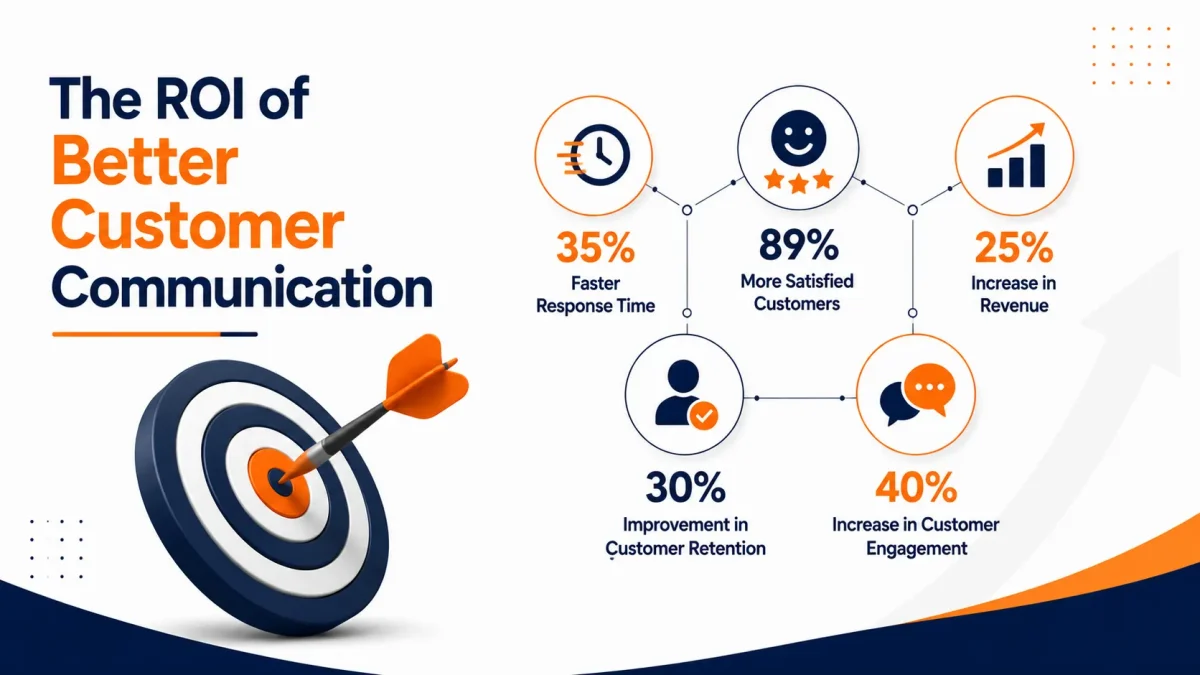

Table of Contents
A potential customer calls after reviewing a company’s services. No one answers, and the caller contacts a competitor.
The business records a missed call. It does not record the lost sale, future revenue, or referrals that may have followed.
This is why customer communication ROI cannot be measured by phone costs alone. The real return appears in faster responses, stronger conversions, higher retention, lower support costs, and fewer conversations lost between teams or channels.
Poor Communication Creates Hidden Business Costs
A delayed or disconnected response can quickly become a commercial problem. In sales, it may mean a lost lead. In support, it may create repeat calls, escalations, or cancellations. In appointment-based businesses, a missed reminder can leave valuable time unfilled.
Common costs include:
- Leads that never receive timely follow-up
- Customers repeating information to different agents
- Calls transferred to the wrong department
- Support requests reopened after incomplete answers
- Employees switching between disconnected tools
- Customers leaving after delays or inconsistent responses
- Revenue opportunities hidden inside missed or unreviewed calls
These losses may appear as higher acquisition costs, customer churn, lower productivity, and increased support workloads rather than as a single communication expense.
What Is Customer Communication ROI?
Customer communication ROI measures the financial gains and cost savings produced by improving how a business handles calls, messages, follow-ups, support requests, and customer interactions.
A basic calculation is:
Customer communication ROI = (Financial gains + cost savings − communication investment) ÷ communication investment × 100
Financial gains may include additional conversions, retained revenue, completed appointments, renewals, and higher customer lifetime value.
Cost savings may come from lower calling expenses, fewer transfers, reduced repeat inquiries, less manual follow-up, lower support costs, and replacing separate communication tools.
The calculation should focus on outcomes. Answering more calls matters, but the number of answered calls that become sales, appointments, resolutions, or retained customers matters more.
Faster Responses Protect Active Customer Intent
Customers do not see an understaffed team, disconnected inboxes, or outdated routing. They experience only the delay.
HubSpot’s customer service research reports that response time remains a major customer experience measure and that many consumers expect support issues to be resolved within hours. View HubSpot’s customer service statistics.
The commercial effect varies by industry:
- A home services company may lose the appointment to the first provider that answers.
- A law firm may lose a prospect after delayed follow-up.
- A healthcare office may miss a consultation booking.
- A B2B company may allow a competitor to shape the decision first.
Better response time protects opportunities while customer intent is still active.
Retention Creates Long-Term Communication ROI
Customer retention develops through repeated experiences. Customers notice whether they can reach the company, receive consistent answers, avoid repeating information, and get promised callbacks.
Poor communication weakens confidence even when the product or service performs well.
A better communication experience can contribute to:
- Renewals and repeat purchases
- Higher customer lifetime value
- More referrals
- Lower replacement acquisition costs
- Fewer cancellation-related escalations
- Less discounting to recover damaged relationships
HubSpot also reports that customers are more likely to return after a positive service interaction. Read HubSpot’s customer service overview.
Businesses can compare retention, churn, renewal rates, repeat purchases, and satisfaction before and after improving communication workflows.
Better Communication Can Convert More Existing Leads
Weak conversion does not always indicate a lead-generation problem. The failure may occur after the inquiry arrives.
A business can generate hundreds of leads and still underperform when:
- Calls go unanswered during busy periods.
- Web inquiries receive next-day responses.
- Leads are transferred without context.
- No employee owns the follow-up.
- Sales teams cannot see previous conversations.
- Managers track volume without tracking outcomes.
Consider a business receiving 400 qualified inquiries each month.
Before improving communication:
- 280 inquiries receive a timely response.
- 20% convert.
- Average first-year customer value is $1,200.
- Monthly revenue is $67,200.
After improving routing, ownership, alerts, and follow-up:
- 340 inquiries receive a timely response.
- 23% convert.
- Monthly revenue increases to $93,840.
The illustrative difference is $26,640 per month. The business did not need more leads. It needed to stop losing the leads it already had.
Support Efficiency Is More Than Shorter Calls
Faster calls do not automatically produce better support. Rushing customers can create repeat contacts, escalations, and unresolved issues.
Communication technology improves support efficiency when it helps teams:
- Route customers correctly
- Access account or CRM information
- Preserve conversation history
- Automate routine updates and reminders
- Provide callbacks instead of extended queue waits
- Review recurring issues and call trends
- Continue conversations across customer-preferred channels
A customer who receives the correct answer once costs less to support than a customer who calls three times.
Employees also gain capacity because they spend less time searching for information, correcting transfers, and recreating notes.
Measure Outcomes, Not Activity Alone
A fast acknowledgment is not the same as a useful response. A quickly answered call transferred four times is not efficient.
Businesses should monitor speed, quality, and results together.
| Metric | What It Should Reveal |
| First Response Time | How quickly customers receive a meaningful response |
| Answer Rate | How many incoming inquiries are handled successfully |
| Abandonment Rate | How many customers leave before getting help |
| First-Contact Resolution | How often issues are resolved in the first interaction |
| Transfer Rate | Whether customers reach the right team without delays |
| Follow-Up Completion | Whether promised follow-ups happen on time |
| Conversion Rate | How many interactions lead to the desired outcome |
| Retention Rate | Whether communication helps retain customers |
| Cost per Resolution | How efficiently issues are resolved |
| Customer Satisfaction | How customers rate their overall experience |
No single metric proves ROI. A shorter call has little value if the customer must call again.
Where the ROI of VoIP Appears
The ROI of VoIP includes more than lower phone bills.
A modern business VoIP phone service can support cloud calling, call forwarding, messaging, virtual reception, call recording, integrations, and communication across office, mobile, and remote teams.
Potential returns include:
- Fewer missed calls
- Faster connection to available employees
- Easier expansion to new users and locations
- Reduced on-premises hardware requirements
- Better continuity for hybrid teams
- Greater visibility into call activity
- Lower maintenance and tool complexity
- More consistent customer-facing communication
Direct savings matter, but stronger call handling and operational flexibility often create broader business value.
Routing, Omnichannel Engagement, and Analytics
Three communication capabilities can directly influence ROI.
Smarter Call Routing
Customers should not need to understand the company’s structure before reaching the right person.
Vitel Global’s Call answering methods and call routing can direct calls by department, schedule, mailbox, business hours, or agent availability.
This can improve answer rates, reduce transfers, support after-hours coverage, and shorten sales or support response times.
Connected Customer Channels
Offering phone, SMS, WhatsApp, and social messaging does not guarantee continuity. The value appears when teams can manage those conversations without losing context.
Vitel Global’s omnichannel engagement platform connects multiple customer channels with centralized messaging, customer data, campaigns, and workflows.
This can reduce duplicate responses, improve ownership, strengthen follow-up, and help customers continue a conversation across channels.
Conversation Intelligence
Call volume shows activity, not performance.
Vitel Global’s AI call analytics and reporting can provide transcripts, summaries, sentiment analysis, conversation highlights, action items, and shareable reports.
These insights can reveal repeated objections, missed follow-ups, negative sentiment, common support issues, and performance differences between campaigns, shifts, or teams.
A Practical Communication ROI Calculation
Begin with one measurable problem.
Problem: Too many qualified calls are missed during busy periods.
Assume the business receives:
- 1,000 inbound calls each month
- 180 missed or abandoned calls
- 40% sales-intent calls
- 25% conversion rate
- $1,500 average first-year customer value
Approximately 72 missed calls may have sales intent. At a 25% conversion rate, that represents 18 potential customers and $27,000 in possible first-year revenue.
After improving routing, queue callbacks, and staffing alerts, missed calls fall from 180 to 70. The business recovers 110 conversations.
Using the same assumptions:
- 44 may be sales opportunities.
- 11 may convert.
- Potential first-year revenue gained is $16,500.
If reduced callbacks, escalations, and separate system costs save another $1,500, the monthly financial benefit becomes $18,000.
If the communication investment is $3,500 per month:
Estimated ROI = ($18,000 − $3,500) ÷ $3,500 × 100 = 414%
This is an illustrative model. Each business should use its own customer value, conversion rate, call intent, staffing costs, and technology expenses.
Include the Full Cost of the Investment
A credible ROI calculation should include:
- Software and service fees
- Numbers and usage
- Setup and number porting
- Integrations
- Employee training
- Workflow configuration
- Data migration
- Hardware, where required
- Ongoing administration
- Security and compliance requirements
Businesses should also allow time for adoption, workflow refinement, and reporting accuracy. A realistic calculation is more useful than an inflated figure that cannot be defended.
How to Measure Communication ROI
Keep the process focused.
Establish the Baseline
Record response time, missed calls, answer rate, conversion, retention, first-contact resolution, repeat contacts, support cost, and technology expenses.
Compare Results After the Change
Use the same metrics over a meaningful period. Account for seasonality, campaigns, staffing changes, and unusual business events.
Translate Improvement into Value
Connect operational gains with revenue gained, revenue retained, employee time saved, costs avoided, additional capacity, and tools replaced.
Validate the Trend
Confirm that results continue. A temporary conversion increase may come from a strong campaign rather than better communication.
Mistakes That Reduce Communication Technology ROI
Buying Features Without a Defined Problem
Technology should solve specific issues involving routing, availability, context, follow-up, reporting, or scalability.
Replacing Technology Without Fixing Workflows
A new system cannot correct unclear ownership. Teams still need response, escalation, and follow-up rules.
Measuring Volume Instead of Results
More calls, messages, and shorter durations do not automatically indicate improvement.
Ignoring Employee Adoption
Teams may avoid technology that is difficult to use or poorly connected to daily workflows.
Automating Without Human Escalation
Automation should handle appropriate routine tasks while allowing customers to reach a capable employee when judgment is required.
How Vitel Global Supports Communication ROI
Vitel Global brings business calling, messaging, meetings, call management, omnichannel engagement, and communication analytics together in a cloud communication environment.
Businesses can use Vitel Global for:
- VoIP calling across office, remote, and mobile teams
- Call forwarding, queues, and answering rules
- Virtual reception and automated call handling
- Business SMS and team messaging
- Omnichannel customer engagement
- Call recording and performance reporting
- AI-generated transcripts and summaries
- Sentiment and conversation insights
- CRM and business-tool integrations
Its advanced call management capabilities include interactive voice response, monitoring, recording, CRM integration, analytics, and performance visibility.
The real test is not whether a business replaced its old phone system. It is whether more customers receive answers, more leads progress, fewer issues require repeat contact, and teams work more efficiently.
Stop Losing Customers Due to Missed Communication
Improve response times, capture every opportunity, and turn conversations into revenue.
Frequently Asked Questions
1. What is customer communication ROI?
Customer communication ROI measures the revenue gains and cost savings created through faster responses, better call handling, stronger follow-up, improved support, and connected communication technology.
2. What is the ROI of VoIP for businesses?
VoIP ROI may include lower calling and maintenance costs, easier scalability, greater mobility, fewer missed calls, better routing, integrated messaging, and improved productivity.
3. How does Vitel Global improve customer communication ROI?
Vitel Global connects calling, messaging, routing, omnichannel engagement, and communication analytics. These capabilities can reduce missed opportunities, improve response times, and streamline sales and support workflows.
4. Can Vitel Global help reduce missed calls?
Yes. Call forwarding, answering rules, queues, virtual reception, and availability-based routing can direct incoming calls to the right employee, team, or workflow.
5. Does Vitel Global support omnichannel communication?
Yes. Vitel Global supports customer engagement across voice, SMS, WhatsApp, and social messaging, helping teams manage conversations with greater continuity.
6. Which metrics should businesses track?
Businesses should monitor answer rate, missed calls, response time, abandonment, first-contact resolution, conversion, retention, support costs, follow-up completion, and customer satisfaction.
7. How long does communication ROI take to measure?
Missed-call and response-time improvements may appear quickly. Retention, customer lifetime value, and long-term cost savings require a longer measurement period.
Published: July 22nd, 2026
Subscribe to Our Latest Updates
Get monthly product and feature updates, the latest industry news, and more!