



Lead Routing Best Practices for Sales Teams
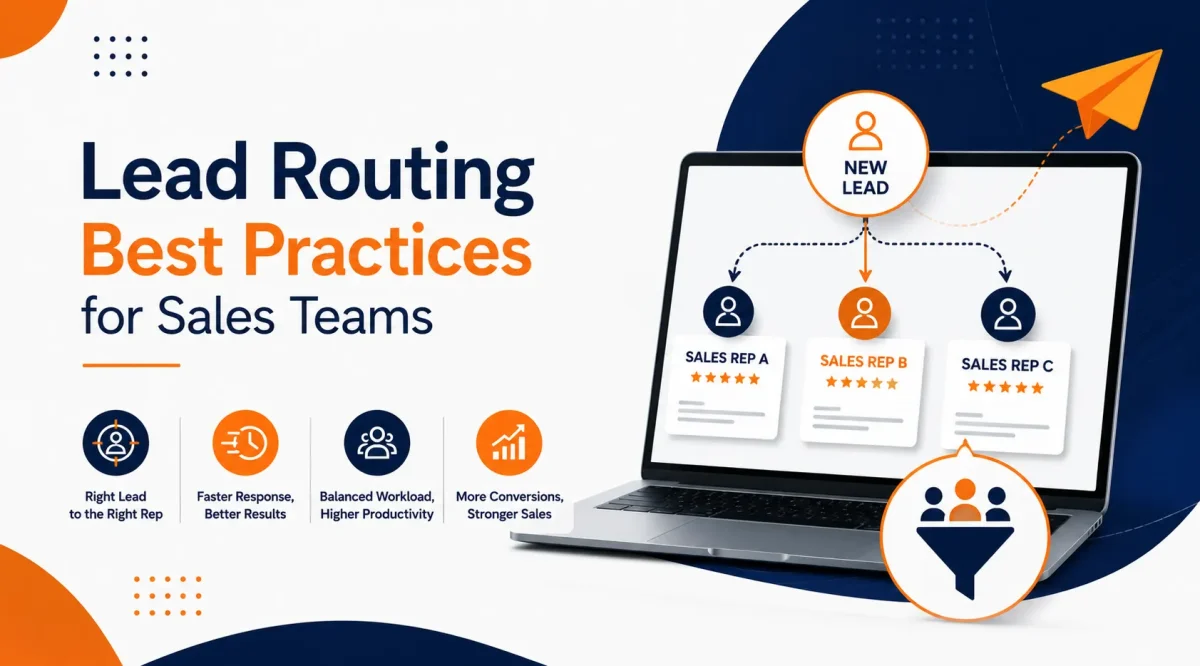

Table of Contents
Effective lead routing ensures every new inquiry reaches the salesperson most likely to respond, qualify the opportunity, and move it forward. Without a clear routing process, leads remain unassigned, reach unavailable representatives, or pass between teams without accountability.
Modern sales teams need more than basic sales assignment rules. They need automated qualification, clear response-time expectations, real-time availability checks, and CRM-connected communication. The objective is not merely to distribute leads evenly. It is to connect each prospect with the right representative before interest declines.
What Is Lead Routing?
Lead routing is the process of assigning an incoming prospect to the appropriate salesperson, queue, or team based on criteria such as location, product interest, account ownership, lead score, language, availability, and representative capacity.
A lead may enter the routing process through:
- A website form
- An inbound phone call
- Live chat
- SMS or WhatsApp
- A paid advertising campaign
- An event or webinar
- A referral partner
- A CRM import
- A product trial or demo request
Strong routing connects these sources to a consistent ownership and follow-up process.
Why Does Lead Routing Matter?
Lead generation creates an opportunity, but routing determines whether that opportunity receives attention.
Poor routing can cause:
- Delayed first contact
- Duplicate outreach
- Unequal representative workloads
- Leads assigned outside the correct territory
- Existing customers treated as new prospects
- High-value opportunities sent to inexperienced representatives
- Unclear ownership between marketing and sales
- Missed follow-ups during evenings or weekends
Lead management is a process that includes capturing, qualifying, routing, nurturing, and tracking leads from initial contact through conversion. A structured system can help improve marketing-to-sales handoffs, qualification, ownership, and follow-up.
Vitel Global also explains how faster lead response and call routing can reduce delays and move prospects toward the correct representative or next action.
Which Lead Routing Method Should a Sales Team Use?
The best model depends on the company’s sales structure, customer segments, and lead volume.
| Routing Method | How It Works | Best Suited For |
| Round Robin | Distributes leads sequentially across eligible representatives | Teams handling similar products, territories, and experience levels |
| Territory-Based | Assigns leads based on geographic factors like country, state, city, or ZIP/postal code | Regional sales teams and field-based operations |
| Account-Based | Routes leads to the existing account owner or manager | Enterprise sales and account-based selling strategies |
| Skill-Based | Matches leads with representatives based on product expertise, industry knowledge, or language skills | Complex products and specialized sales teams |
| Capacity-Based | Assigns leads according to each representative’s current workload and availability | High-volume teams with fluctuating workloads |
| Weighted Routing | Allocates more leads to selected representatives based on performance or experience | Teams with mixed experience or performance levels |
| Intent-Based | Prioritizes leads based on urgency or buying signals (e.g., demo requests, pricing inquiries) | Inbound sales teams handling high-intent prospects |
Round robin lead assignment involves assigning each new lead to a different eligible user until everyone receives an equal share and the cycle repeats.
Round robin is simple and fair, but it should not be applied indiscriminately. A strategic account inquiry, for example, should not enter the same rotation as a low-intent content download.
1. Define Lead Ownership Before Adding Automation
Routing technology cannot fix an unclear sales process.
Before creating rules, document:
- Which leads belong to sales
- Which inquiries remain with marketing
- Who owns existing customer expansion opportunities
- Who manages partner and referral leads
- Which team handles different products
- How geographic ownership works
- When ownership transfers from an SDR to an account executive
- What happens when the assigned person is unavailable
Each lead should have one accountable owner at every stage.
Without defined ownership, routing automation may move records faster while preserving the same internal confusion.
2. Segment Leads Before Assigning Them
Not every inquiry deserves the same path.
Sales teams should classify leads using information such as:
- Product or service interest
- Company size
- Industry
- Geographic location
- Existing account relationship
- Estimated deal value
- Lead source
- Buyer role
- Engagement level
- Purchase timeframe
High-intent leads requesting pricing, a consultation, or a live demonstration should receive a faster path than contacts downloading introductory content.
Automatic lead routing can evaluate factors such as product, region, fit, intent, and representative availability before assigning a lead.
This creates intelligent lead distribution rather than equal distribution without context.
3. Match the Routing Model to the Sales Structure
Many businesses need a hybrid system rather than one universal rule.
A practical routing hierarchy may work as follows:
- Match the lead with an existing customer or open opportunity.
- Check whether a named account owner already exists.
- Route by product, industry, or language requirements.
- Apply sales territory routing where geographic ownership matters.
- Check representative availability and capacity.
- Use round robin among the remaining eligible representatives.
- Send unmatched records to an exception queue.
Specific rules should run before general rules. Otherwise, a broad round robin rule may capture leads intended for strategic accounts or specialist teams.
4. Establish a Lead Response SLA
An SLA, or service-level agreement, defines how quickly a salesperson must respond and what happens when the response does not occur.
A lead-routing SLA should identify:
- When the response timer begins
- Which actions qualify as a response
- The response target for each lead category
- Business-hour and after-hours rules
- Required follow-up attempts
- Escalation conditions
- Reassignment timing
- How exceptions are recorded
A high-intent demo request may require contact within minutes, while a lower-intent content lead may enter a scheduled nurture sequence.
Sales and marketing SLA can define the timeframe within which sales agrees to contact leads supplied by marketing.
The SLA should reflect the urgency and value of the inquiry rather than assigning one deadline to every lead.
5. Improve Speed to Lead
Speed to lead measures the time between a prospect’s inquiry and the first meaningful sales response.
Routing time is only one part of this measurement. A lead may be assigned in seconds but remain untouched for hours.
Sales teams should measure:
- Inquiry-to-assignment time
- Assignment-to-first-attempt time
- Inquiry-to-first-conversation time
- First-response SLA attainment
- Reassignment frequency
- Leads never contacted
A LeanData case study reports that Zoom reduced lead-routing time from more than three minutes to under 1.5 minutes, while its lead-to-opportunity conversion rate increased from 11% to 17%. This is a company-specific result, not a universal benchmark, but it illustrates how routing improvements can accompany stronger funnel performance.
Vitel Global’s guide to lead response time explains how smart routing, missed-call tracking, connected communication, and follow-up workflows can help teams respond faster.
6. Route Leads According to Real Availability
Assigning a lead to someone who is on leave, in meetings, or already overloaded creates an avoidable delay.
Routing rules should consider:
- Working hours
- Time zone
- Leave status
- Calendar availability
- Active lead volume
- Open opportunities
- Call queue status
- Maximum daily capacity
Availability-based routing is especially important for inbound calls and urgent requests. When the preferred representative is unavailable, the system should move to a qualified backup rather than sending the prospect directly to voicemail.
Vitel Global’s Follow Me call-routing feature can help direct calls across designated numbers and devices, supporting availability-based business calling.
7. Keep Lead Data Clean
Routing depends on accurate information.
Incorrect locations, missing product fields, and duplicate accounts can send leads to the wrong representative. Before assignment, the system should validate and standardize:
- Country, state, and ZIP or postal code
- Company name
- Business email domain
- Phone number
- Product interest
- Campaign source
- Customer status
- Account ownership
- Consent information
Routing rules should also include a fallback path for incomplete records. A lead should never remain unassigned simply because one field is missing.
8. Match Leads With Existing Accounts
A new form submission may come from:
- An existing customer
- A company with an active opportunity
- A subsidiary of a named account
- A previously disqualified contact
- A former customer
- A duplicate record
Before creating a new assignment, compare the lead’s company, email domain, phone number, and other identifiers with existing CRM data.
Lead-to-account matching prevents competing representatives from contacting the same organization and protects established account relationships.
9. Automate the Handoff With Context
Automating lead handoff should transfer more than a contact record.
The assigned representative should receive:
- Lead name and contact details
- Company and role
- Product or service interest
- Lead source
- Page or campaign that generated the inquiry
- Qualification score
- Previous calls or messages
- Requested callback time
- SLA deadline
- Recommended next action
Vitel Global CRM Integration connects business communications with supported CRM systems, helping teams synchronize customer data, log interactions, and streamline workflows.
The Vitel Global and HubSpot integration also supports two-way contact synchronization, click-to-call, automatic call logging, task automation, and follow-up workflows.
10. Reassign Leads That Remain Untouched
An assignment should not be considered complete until the representative accepts or acts on it.
Create automatic escalation rules when:
- No contact attempt occurs within the SLA
- The assigned representative rejects the lead
- The representative is unavailable
- The lead remains in a new status too long
- A call repeatedly goes unanswered
- The representative reaches capacity
The system can notify a manager, return the lead to a queue, or assign it to the next qualified representative.
Reassignment rules prevent valuable opportunities from remaining hidden in individual CRM views.
11. Connect Calls and Messages to the Routing Process
Website forms are not the only source of leads. Prospects may contact a business through voice, SMS, chat, email, WhatsApp, or social media.
An omnichannel contact center can connect customer interactions across channels, helping teams maintain context and continue conversations without forcing prospects to restart the process.
A connected workflow can:
- Route calls by intent or department
- Capture after-hours inquiries
- Record missed calls
- Trigger SMS follow-up
- Add call notes to the CRM
- Preserve communication history
- Notify the assigned representative
- Escalate urgent requests
Vitel Global’s guide to AI call assistants explains how AI-assisted call handling can identify caller intent, collect lead information, route calls, summarize conversations, and support follow-up workflows.
12. Measure Routing Quality, Not Just Distribution
Equal distribution does not automatically mean effective distribution.
Sales leaders should monitor:
- Average routing time
- Median first-response time
- SLA compliance rate
- Percentage of unassigned leads
- Reassignment rate
- Lead acceptance rate
- Lead-to-meeting conversion
- Lead-to-opportunity conversion
- Conversion by routing method
- Representative workload
- Territory performance
- Revenue by lead source
Teams should also review exception queues and manual overrides. A high number of overrides may indicate that the routing rules no longer reflect the sales organization.
Common Lead Routing Mistakes
Avoid these recurring problems when optimizing lead assignment:
- Sending every lead into one round robin
- Ignoring existing account ownership
- Routing solely by geography
- Assigning leads to unavailable representatives
- Using incomplete or unverified CRM data
- Setting one SLA for every inquiry
- Failing to reassign untouched leads
- Measuring assignment without measuring response
- Losing context during marketing-to-sales handoff
- Leaving unmatched leads without an exception queue
How to Build a Lead Routing Workflow
A practical implementation follows these stages:
Map Lead Sources
Identify every form, phone number, campaign, chatbot, CRM import, and messaging channel that creates leads.
Define Qualification Rules
Determine which inquiries are sales-ready and which should enter marketing nurture or another workflow.
Document Ownership
Define territory, account, product, segment, and representative responsibilities.
Establish SLAs
Set response targets by lead type, urgency, source, and business hours.
Configure Assignment Logic
Apply account matching, territory, skill, capacity, and round robin rules in the correct order.
Add Fallbacks
Create exception queues, backup representatives, reassignment timers, and manager alerts.
Test Real Scenarios
Test duplicates, missing data, existing customers, after-hours inquiries, unavailable representatives, and high-volume periods.
Review Performance
Analyze response time, conversion, workload, and routing exceptions regularly.
How Vitel Global Supports Faster Lead Handoffs
Vitel Global helps sales teams connect inbound calls, business messaging, CRM records, and routing workflows.
With integrated communication, teams can:
- Route inbound calls to the appropriate sales group
- Capture inquiries when representatives are unavailable
- Log calls and messages in connected CRM platforms
- Improve visibility into lead ownership and follow-up
- Send SMS messages after missed calls
- Support remote and multi-location sales teams
- Maintain context during transfers and escalations
- Track conversations across the sales process
This communication layer supports routing automation by helping representatives act on assigned leads without switching between disconnected systems.
Businesses can also connect Vitel Global with supported CRM platforms through:
- Salesforce integration
- HubSpot integration
- Zoho CRM integration
- Vtiger integration
- Microsoft Dynamics integration
These integration pages describe features such as call logging, contact synchronization, click-to-call, customer-history access, analytics, and workflow support.
Route Leads Faster and Close More Deals
Optimize lead distribution with smart routing tools designed for high-performing sales teams.
Frequently Asked Questions
1. How does Vitel Global help with lead routing?
Vitel Global can route inbound calls to appropriate departments, teams, or representatives while connecting communication records with supported CRM platforms for clearer ownership and follow-up.
2. Can Vitel Global support round robin lead routing?
Vitel Global supports call distribution and CRM-connected communication workflows. Round robin sales assignment may be configured through the CRM, contact center, or routing system selected by the organization.
3. Does Vitel Global integrate with sales CRM systems?
Yes. Vitel Global offers integrations for platforms such as Salesforce, HubSpot, Zoho CRM, Vtiger, and Microsoft Dynamics.
4. Can Vitel Global improve speed to lead?
Vitel Global can help reduce communication delays through call routing, missed-call visibility, SMS follow-up, CRM logging, and AI-assisted inquiry capture. Results depend on the organization’s complete routing rules, representative availability, and SLA process.
5. Can leads be captured outside business hours?
AI-assisted call handling, voicemail, messaging, and automated workflows can capture caller information and direct it toward the appropriate follow-up process.
6. Can Vitel Global support territory-based sales teams?
Yes. Cloud communication, business numbers, call routing, and CRM integrations can support sales representatives working across different offices, regions, and time zones.
Published: July 17th, 2026
Subscribe to Our Latest Updates
Get monthly product and feature updates, the latest industry news, and more!