


VoIP Vs PBX: What’s Best for Your Business
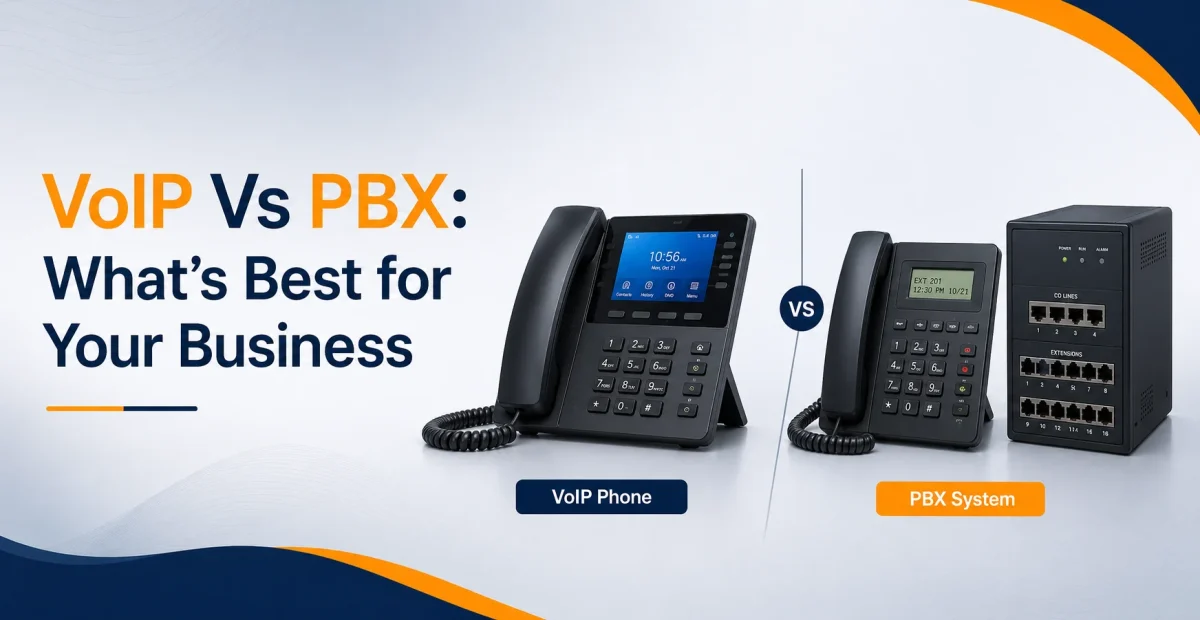

Table of Contents
When businesses compare VoIP vs. PBX, they are usually trying to answer a bigger question than technology alone. They want to know which phone system will cost less to manage, support a growing team better, fit remote work more naturally, and give them a cleaner communication setup without adding more operational drag. That decision matters because your phone system affects sales conversations, support response, internal coordination, call quality, and how easily your business can adapt when the team grows or work shifts across locations.
For many companies, the choice is no longer between an old office phone model and a new one. It is between keeping communication tied to office hardware or moving toward a more flexible business calling structure. Vitel Global’s business phone environment already reflects that modern direction through cloud-based calling, call routing, call forwarding, voicemail-to-email, desktop and mobile apps, CRM integration, and cloud PBX support built for business use.
Move Beyond Office-Bound Phone Systems
See how Vitel Global helps your team switch from rigid PBX infrastructure to flexible cloud business calling.
What Is PBX?
PBX stands for Private Branch Exchange. It is a private business phone system that lets employees place internal calls, handle outside calls, transfer callers, and manage company extensions from one structured phone environment. In its more traditional form, PBX depends on on-site hardware, office installation, and physical telecom infrastructure.
A PBX setup can still work well for businesses that want more direct control over their internal phone environment or already have existing telecom investment in place. It can support internal extensions, voicemail, call queues, interactive voice menus, and call handling inside the office. Vitel Global’s own support documentation also explains PBX as a private business telephone network that can support internal communication, call transfers, voicemail, call recording, IVRs, and call queues.
What Is VoIP?
VoIP stands for Voice over Internet Protocol. It allows businesses to make and receive calls over the internet rather than relying only on traditional phone lines. Instead of locking business calling to office hardware, VoIP gives teams more freedom to answer from desk phones, laptops, desktop softphones, or mobile apps, depending on how the business works.
That shift changes more than call delivery. It also opens the door to a broader communication setup built around routing, analytics, integrations, messaging, conferencing, and multi-device access. Vitel Global’s business phone materials describe VoIP calling as cloud-based business calling that works through an active internet connection and supports flexibility, routing, transcription, CRM links, and multi-device use.
How PBX Works
A PBX system acts like the internal call control layer for the business. It routes inbound and outbound calls, manages extensions, and supports communication across employees without forcing every call through separate direct lines.
With a traditional on-premise PBX, the company usually owns or manages the phone hardware inside the office. That can appeal to businesses with internal telecom support and established infrastructure. It can also mean:
- more hardware to maintain
- more effort when expanding
- more dependence on office-based equipment
- more responsibility on internal IT or telecom support
How VoIP Works
VoIP converts voice into digital packets and sends them through the internet to the receiving endpoint. That endpoint could be an office phone, mobile app, desktop app, or browser-based communication layer.
The practical result is that the business is no longer forced to tie every call to one office location. Teams can answer from the tools they already use. Vitel Global supports that type of structure through desktop app access, mobile app access, simultaneous ring across devices, number portability, CRM integration, and cloud PBX functionality.
VoIP vs PBX: Key Differences That Affect Real Business Use
When businesses compare VoIP and PBX, the decision usually comes down to how much control they want to keep inside the office and how much flexibility they want the system to deliver outside it.
Technology
PBX is rooted in a private business phone exchange, often built around office hardware and more fixed telecom infrastructure. VoIP uses the Internet Protocol to carry voice, which gives businesses a more flexible way to manage calling across users and locations.
Setup and Maintenance
PBX usually takes more hands-on setup and more ongoing maintenance. If the business adds lines, changes office layouts, or expands departments, the changes often involve more work and more coordination.
VoIP usually reduces that burden. User provisioning, call routing changes, number assignments, and device access can often be managed far more quickly through the provider environment.
Scalability
This is one of the biggest separation points in VoIP vs. PBX.
PBX growth can require more physical planning, more hardware, and more budget. VoIP growth is usually lighter. Businesses can add users, departments, numbers, and routing logic without rebuilding the system around office hardware every time growth happens.
Mobility
PBX is usually better suited to fixed office use. VoIP supports distributed work much more naturally. This matters for:
- remote teams
- hybrid staff
- managers moving between locations
- sales and service teams working in the field
Features
Both systems can support business calling, though VoIP environments usually provide a broader feature set around the call itself. That can include:
- voicemail-to-email
- business texting
- mobile and desktop apps
- call recording
- analytics
- Video conferencing
- CRM integration
- shared number management
Compare VoIP and PBX With a Real Business Use Case
Find out which setup fits your team, budget, growth plans, and day-to-day communication needs.
PBX vs VoIP Comparison Table
| Category | PBX | VoIP |
| Call delivery | Office telecom infrastructure | Internet-based voice delivery |
| Setup model | More hardware-focused | More software and provider-focused |
| Expansion | Often slower and costlier | Usually faster and lighter |
| Remote work support | More limited | Strong |
| Office dependence | High | Low |
| Device flexibility | Narrower | Broader |
| Maintenance load | Higher | Lower |
| Business agility | Lower | Higher |
The biggest difference in VoIP vs PBX comes down to how the system is delivered and how flexible it is after deployment.
A traditional PBX usually depends more heavily on office hardware and physical setup. VoIP depends on internet-based call delivery and can be managed in a more flexible way across users, devices, and locations.
That one difference affects almost everything else:
- setup effort
- ongoing maintenance
- growth cost
- remote work support
- user access
- integrations
- business agility
For businesses trying to modernize communication, this is why the difference between VoIP and PBX matters so much. One model is more rooted in office infrastructure. The other fits a business environment where users, customers, and teams may be working from more than one place.
Hosted PBX vs VoIP
A lot of businesses get confused here because these terms overlap.
Hosted PBX vs VoIP is not really a fight between two fully separate ideas. VoIP is the internet-based voice technology. Hosted PBX is a business phone system model that often uses VoIP to deliver call management, routing, extensions, and voicemail without putting the PBX hardware inside your office.
So the cleaner way to understand it is this:
- VoIP is the voice delivery method
- Hosted PBX is the broader managed phone system built around that method
Vitel Global’s training material describes cloud PBX as a hosted or virtual PBX system managed on the cloud, giving businesses affordability, easier setup, scalability, geographic flexibility, analytics, and stronger employee flexibility.
Cloud PBX vs VoIP
The same overlap applies in cloud PBX vs VoIP comparisons.
Cloud PBX refers to the full business phone environment delivered from the cloud. VoIP refers to the technology that carries voice over the internet. A business can use VoIP inside a larger cloud PBX setup that includes:
- extensions
- voicemail
- call routing
- auto attendants
- business numbers
- reports
- user management
This matters because buyers often ask the wrong question. Instead of only asking whether they need VoIP, they should ask whether they need a broader business communication setup around that voice layer.
PBX Phone System vs VoIP: Cost, Flexibility, and Growth
The most practical PBX phone system vs VoIP comparison usually comes down to three things.
Cost
A PBX setup often comes with a higher upfront cost because of hardware, installation, maintenance, and office-based infrastructure. VoIP usually lowers that burden because the business can use cloud delivery and supported devices instead of building everything around physical office telecom equipment.
Flexibility
A PBX model is more office-centered. VoIP is more location-flexible. That makes VoIP far more attractive for hybrid teams, remote staff, traveling sales teams, and businesses with more than one office.
Growth
A PBX can be expanded, though the process often involves more hardware or telecom changes. VoIP usually gives businesses a lighter expansion path through user changes, software-based management, and cloud-based scaling.
VoIP and PBX: Which One Fits Your Team Better?
The answer depends on how your business actually works. A PBX may still make sense if:
- The company already has a strong office telecom investment
- Businesses prefer tighter physical control over internal phone hardware
- Workflow is mostly office-based
- Your internal support team can manage it comfortably
VoIP is often the stronger choice if:
- Team works across locations
- You want easier user expansion
- Need for mobile and desktop calling
- You want cleaner integration with CRM and business tools
- You want to reduce the office hardware burden
- Calling, routing, reporting, and communication access in one lighter environment is required
This is where Vitel Global becomes relevant in the buying decision. Its business phone environment already includes cloud-based calling, HD voice, call forwarding, call summaries, auto transcriptions, smart routing, department lines, mobile app use, desktop app use, and CRM-linked workflows that fit the direction many growing businesses are moving toward.
PBX vs UCaaS
A lot of modern businesses are no longer stopping at PBX vs UCaaS as a simple phone question. They are asking whether the business should keep only a phone system mindset or move toward a broader communication environment.
PBX focuses mainly on business telephony. UCaaS expands communication into a more connected model that can include:
- voice
- messaging
- meetings
- collaboration
- CRM-linked communication
- mobile and desktop access
That shift matters because modern teams rarely communicate through calls alone.
What Advantage Does VoIP Offer Over PBX?
The real advantage is not only cheaper calling. VoIP gives businesses more flexibility as communication needs expand across teams, locations, and devices.
A VoIP environment can support:
- business calling across devices
- cleaner expansion as teams grow
- faster number and user changes
- easier access for distributed staff
- stronger routing for customer-facing teams
- better alignment with CRM and workflow tools
That is why many companies no longer treat PBX phone systems vs. VoIP as a narrow telecom debate. They see it as an operating decision. One model keeps communications more fixed. The other helps communication move within the business.
See What Modern Business Calling Looks Like
Discover how Vitel Global brings cloud calling, messaging, conferencing, and CRM-connected communication into one place.
Is PBX Still Worth It?
PBX is not obsolete just because VoIP is more widely adopted now. There are still cases where PBX may fit well. PBX can still make sense for:
- businesses with existing telecom investment, they want to keep using
- organizations with office-bound communication patterns
- environments where internal hardware control matters more than mobility
- teams with stable office locations and a low appetite for system change
The issue is not that the PBX cannot work. It is that many businesses have changed how they operate. Once staff work across locations, departments need more visibility, and customers expect faster routing and response. PBX can start to feel restrictive.
Is VoIP Worth Switching To?
For many businesses, yes. A VoIP move often becomes worth it when the company wants:
- Lower infrastructure burden
- Easier support for remote and hybrid work
- Cleaner user management
- Better call visibility
- More flexible business communication
- Connected tools around calling
The shift can also make sense when the business is already frustrated by older office phone limitations. A lot of companies do not move because the current system has fully failed. They move because the older setup has become harder to justify.
What to Consider Before Migrating to VoIP
Before making the switch, a business should evaluate the operational side, not just the feature list.
Internet Readiness
Internet quality matters. A VoIP environment depends on stable connectivity, especially if many users take calls at the same time.
Device Planning
The business should decide whether users will work through:
- IP desk phones
- desktop softphones
- mobile apps
- browser-based access
Number Porting
If the business wants to keep current numbers, number portability should be planned early.
Routing Logic
Departments, extensions, business hours, voicemail flows, call queues, and forwarding rules should be mapped before rollout.
Team Readiness
Even a good system can feel messy if teams are not trained on how to use it.
Real Business Situations Where VoIP Usually Wins
VoIP usually becomes the stronger choice in situations like these:
Multi-location operations
A company with offices in more than one city often wants one connected communication layer instead of isolated office phone islands.
Remote and hybrid work
A business with remote employees needs professional calling outside the office without losing business identity.
Growing support teams
Support environments often need routing, recordings, extensions, and reporting that are easier to manage in a cloud-based setup.
Mobile sales teams
Sales teams need business numbers, mobile access, and follow-up visibility without depending on office hardware.
Plan Your Move From PBX to Smarter Business Communication
Talk with Vitel Global about a cleaner path to cloud-based calling and better team connectivity.
How Vitel Global Unifies Business Communication Beyond VoIP vs PBX
Vitel Global is well-positioned for businesses choosing the VoIP path because it does not stop at internet-based calling alone. It gives businesses a broader communication structure built around how teams and customers actually interact now.
That includes:
- business phone service
- cloud PBX support
- call routing and call forwarding
- voicemail-to-email
- business messaging
- video conferencing
- CRM integration
- communication APIs
- UCaaS support
This matters because most businesses comparing cloud PBX vs VoIP or hosted PBX vs VoIP are not really shopping for a technical term. They are trying to find a communication setup that removes friction, supports customers better, and fits future growth without becoming another burden.
Vitel Global fits that direction well because it supports business communication as one connected environment instead of pushing teams into scattered tools and disconnected workflows.
Final Verdict on VoIP vs PBX
If your business depends on office-bound hardware, already has established telecom infrastructure, and prefers a more fixed internal setup, PBX can still work.
If your business wants flexibility, easier scaling, remote readiness, broader features, and less infrastructure drag, VoIP is usually the stronger long-term choice.
That is why, for many modern businesses, the answer to VoIP vs PBX is leaning more clearly toward VoIP. It matches the way teams work now, the way customers expect to connect, and the way growing businesses need communication to function across offices, homes, laptops, mobile devices, and customer-facing systems.
Move Beyond Office-Bound Phone Limits
Choose Vitel Global for business calling built for growth, flexibility, and cleaner communication.
Frequently Asked Questions
1. What is the main difference between VoIP and PBX?
The main difference is that PBX is usually more dependent on office hardware and fixed telecom infrastructure, while VoIP uses the internet to deliver calling with more flexibility across users, devices, and locations.
2. Is hosted PBX vs VoIP the same comparison?
Not exactly. In hosted PBX vs. VoIP, VoIP is the voice delivery method, while hosted PBX is a full managed phone system that often runs on VoIP technology.
3. What is the difference between VoIP and PBX for small businesses?
For small businesses, the difference between VoIP and PBX usually comes down to cost, setup burden, and flexibility. VoIP is often easier to deploy, easier to scale, and better suited to mobile or hybrid work.
4. Is cloud PBX vs VoIP a direct comparison?
Not fully. In cloud PBX vs. VoIP, cloud PBX refers to the larger hosted business phone setup, while VoIP refers to the voice technology inside that setup.
5. Can businesses keep their phone numbers when switching from PBX to VoIP?
Yes, in many cases, businesses can port their existing numbers when moving to a VoIP environment, though the transfer should be planned early in the process.
6. How does PBX vs UCaaS differ?
Pbx vs UCaaS is a broader comparison. PBX focuses mainly on business telephony, while UCaaS usually includes calling, messaging, meetings, and collaboration inside one connected environment.
7. Is VoIP reliable enough for business use?
Yes, if the internet connection and provider infrastructure are strong. For many businesses, VoIP is fully reliable for daily communication and customer-facing operations.
8. Which option is better for remote teams?
VoIP is usually the better choice for remote and hybrid teams because users can make and receive calls from internet-connected devices without depending on office-bound hardware.
Published: May 21st, 2026
Subscribe to Our Latest Updates
Get monthly product and feature updates, the latest industry news, and more!