



How to Use SMS for Faster Lead Follow-Up
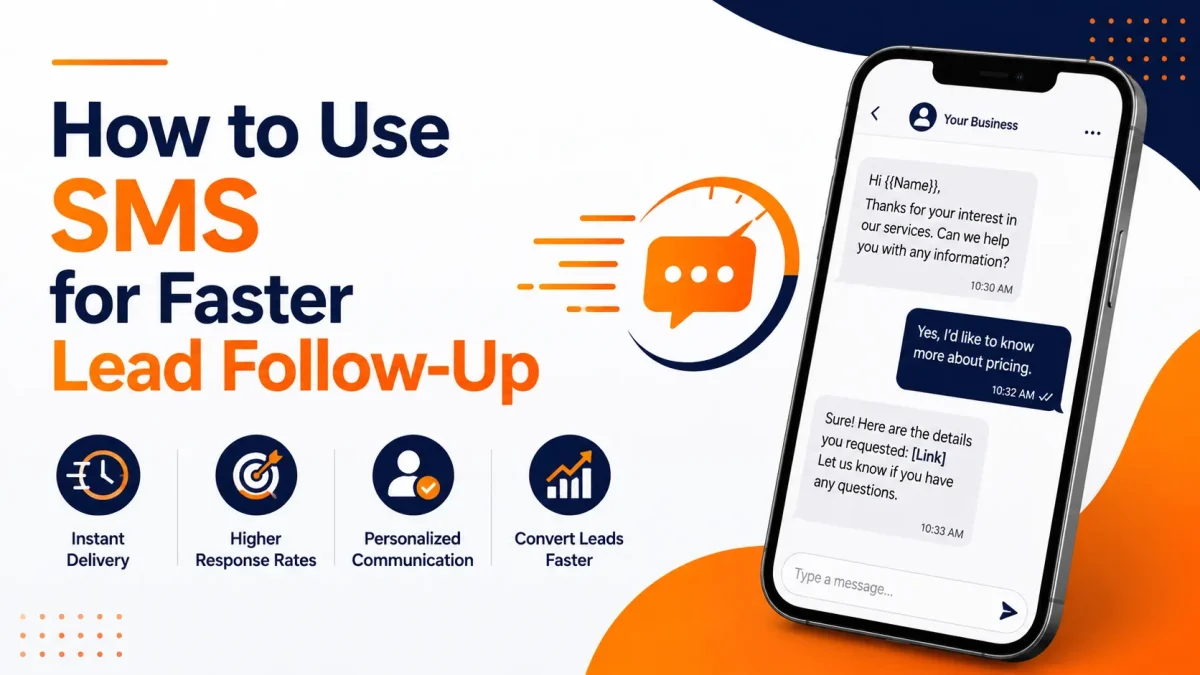

Table of Contents
Keeping your leads engaged is essential for business growth. The moment a prospect submits a form, your sales team should be ready to respond without delay. A quick response increases the chances of converting that lead into a customer.
If your team is busy handling other conversations, delayed follow-ups can cost valuable opportunities. Prospects may lose interest, choose a competitor, or stop responding altogether. With an automated lead engagement process, every new inquiry receives an immediate response, ensuring no opportunity is missed while your sales team focuses on closing deals.
An SMS lead follow up process closes that response gap by acknowledging the inquiry, starting a conversation, and guiding the prospect toward the next action.
The goal is not to replace sales calls. It is to make sure every serious inquiry receives a timely response.
Respond while your leads are still interested. Explore Vitel SMS to manage automated replies, two-way texting, personalized campaigns, and customer conversations from one platform.
Why Does SMS Work for Faster Lead Follow-Up?
SMS works because it gives businesses a direct way to reach leads without requiring them to answer a call, check an inbox, or open another application.
A prospect may be unable to speak when submitting a form. They can still read a short message and respond with a convenient time for a call.
Text messaging can help sales teams:
- Confirm that an inquiry was received
- Respond outside normal office hours
- Ask one simple qualifying question
- Offer available appointment times
- Recover missed calls
- Remind prospects about scheduled consultations
- Continue conversations after unsuccessful call attempts
SMS is particularly useful during the period between initial interest and human contact. It reassures the prospect that the business has received the inquiry and gives them a simple next step.
How Quickly Should a Business Text a New Lead?
A business should send an initial acknowledgment as soon as the lead completes a form, requests a quote, sends an inquiry, or places an unanswered call.
The first message does not need to complete the sale. It should confirm receipt and establish what happens next.
For example:
Hi Sarah, thanks for requesting a consultation with BrightPath Solutions. A member of our team will call you shortly. Is morning or afternoon more convenient?
This message does four things:
- Confirms that the request reached the business
- Identifies the company
- Sets an expectation
- Asks an easy question
The sales representative can then continue the conversation with context rather than beginning with another cold introduction.
Businesses experiencing gaps between initial inquiries and sales activity should also review how to stop losing leads after the first inquiry.
What Should the First SMS Lead Follow-Up Message Say?
The first message should be brief, specific, and easy to answer.
It should normally include:
- The lead’s name
- The company’s identity
- The reason for the message
- The next step
- A simple response option
A useful lead follow-up message could say:
Hi David, this is Maya from NorthPoint Insurance. We received your request for a business insurance quote. Are you available for a five-minute call today?
Avoid starting with a long sales pitch, multiple links, or several questions.
A lead who has just submitted an inquiry does not need the complete product story. They need confirmation that a real business is responding and a clear way to move forward.
How Do SMS Autoresponders Support Lead Conversion?
SMS autoresponders send a predefined message after a specific customer action.
They are useful when an immediate human response is not possible, including:
- After-hours form submissions
- Missed calls
- Quote requests
- Demo requests
- Website chat escalations
- Appointment bookings
- Event registrations
- Product information requests
The autoresponder acknowledges the lead, while the sales team receives time to prepare a more informed response.
A practical after-hours message could be:
Thanks for contacting Westline Services. Our office is currently closed, but your request has been received. Would you prefer a call between 9–11 a.m. or 2–4 p.m. tomorrow?
This is more useful than a generic message stating that someone will respond “soon.”
It sets a clear expectation and encourages the lead to participate in scheduling the next contact.
What Is an Effective SMS Lead Follow-Up Sequence?
An effective sequence changes according to what the lead has already done. Businesses should not send the same message repeatedly.
| Lead Stage | Suggested SMS | Recommended Next Action |
| Immediately after inquiry | Confirm receipt and ask preferred contact time | Assign to representative |
| After an unanswered call | Mention attempted call and offer another time | Schedule callback |
| No response after one day | Restate service and offer help | Ask qualifying question |
| Appointment booked | Confirm date, time, and requirements | Send calendar invite |
| Before the appointment | Send reminder with reschedule option | Confirm or reschedule |
| After the consultation | Summarize next step | Send proposal/payment link |
| Lead becomes inactive | Ask if assistance is still needed | Close, pause, or nurture |
This sequence keeps communication relevant without overwhelming the prospect.
The timing should also reflect the purchase. An urgent home repair inquiry requires a different response schedule from a six-month enterprise software evaluation.
How Can Businesses Use Text Messaging for Lead Generation?
Using text for lead gen starts before the first message is sent.
Businesses must first create clear opportunities for prospects to request SMS communication.
These may include:
- Website quote forms
- Click-to-text advertisements
- Landing-page contact forms
- QR codes at events
- Consultation requests
- Webinar registrations
- Missed-call responses
- Existing customer referrals
The form should explain what messages the prospect can expect and obtain the appropriate consent.
Once the lead enters the workflow, text messaging should help move the conversation toward a business result. That could mean booking an appointment, completing qualification, confirming interest, or arranging a call.
Collecting mobile numbers without a defined follow-up workflow simply creates another unused lead list.
Which Business SMS Strategies Improve Lead Conversion?
The strongest business SMS strategies make it easier for leads to take the next step.
Ask one question at a time
Multiple questions create friction. Begin with the detail needed to decide the next action.
For example:
Which service location would you like us to quote?
After receiving the answer, the representative can ask about timing, budget, or requirements.
Offer specific appointment options
“Let us know when you are free” places the scheduling work on the prospect.
A more useful message would be:
We have consultation openings at 11:30 a.m. and 3:00 p.m. tomorrow. Would either time work for you?
Continue from the original inquiry
The message should mention the service, product, property, appointment, or request that generated the lead.
Context makes the text feel like a response rather than an unrelated promotion.
Provide a human handoff
Automation should not trap a lead inside a fixed sequence. Give prospects a clear way to speak with someone when the conversation becomes more detailed.
Stop unnecessary messages
Once the lead books, declines, opts out, or becomes a customer, the original lead sequence should stop automatically.
How Can Appointment Reminders Prevent Lost Conversions?
Lead conversion does not end when an appointment is booked.
A prospect may forget the meeting, overlook the calendar invitation, or fail to prepare the required information. Appointment reminders reduce this gap by restating the time and making confirmation easy.
A useful reminder could say:
Reminder: Your consultation with GreenStone Financial is tomorrow at 2:00 p.m. Reply C to confirm or R if you need to reschedule.
Businesses can also send reminders for:
- Product demonstrations
- Property viewings
- Insurance consultations
- Medical appointments
- Service estimates
- Recruitment interviews
- Sales discovery calls
- Installation visits
The reminder should arrive early enough for the prospect to act. Sending it only a few minutes before the meeting gives the business little time to fill a cancelled slot.
How Should B2B SMS Marketing Be Used?
B2B SMS marketing should focus on timely, useful communication rather than frequent promotional blasts.
Business buyers may use text messaging to:
- Confirm a discovery call
- Share their availability
- Receive an event reminder
- Approve a meeting change
- Request a callback
- Confirm that a proposal was received
- Receive a short deadline reminder
Text message marketing for sales works best when it supports an existing business conversation.
For example, after sending a detailed proposal by email, a sales representative may send:
Hi Mark, the proposal for your five-location phone system has been emailed. Please let me know if you would like to review the pricing together tomorrow.
The proposal remains in email, where the buyer can review it properly. The SMS prompts the next action.
This coordinated approach is more useful than forcing every stage of a complex B2B sale into text messages.
Disconnected communication tools can also create missed responses. Read Omnichannel Messaging vs Single-Channel Outreach to understand how calls, SMS, email, and messaging channels can work together.
Leads should not wait while teams switch between separate inboxes. Schedule a Vitel Global demo to explore connected business calling and SMS workflows.
How Can Sales Teams Personalize SMS Follow-Ups?
Personalization should reflect the prospect’s actual inquiry, not merely insert a first name.
Useful personalization may include:
- Requested service
- Product category
- Preferred location
- Appointment date
- Assigned sales representative
- Previous conversation
- Requested price range
- Lead source
- Agreed next step
Compare these messages:
Generic message:
Hi Alex, we would like to tell you about our services. Reply to learn more.
Contextual message:
Hi Alex, this is Nina from Apex Moving. We received your request for an office move estimate in Dallas. Is the move planned for August or September?
The second message gives the lead a reason to respond because it continues the conversation they started.
Personalization must still be accurate. Incorrect names, services, dates, or locations can damage trust faster than an unpersonalized message.
How Should SMS Response Rates Be Measured?
SMS response rates should be measured against the action each message was designed to produce.
Relevant performance indicators include:
- Messages delivered
- Leads who replied
- Time to first response
- Appointments booked
- Appointments confirmed
- Calls connected after texting
- Leads qualified
- Proposals requested
- Opt-out requests
- Leads converted into customers
The basic response-rate calculation is:
Response rate = Number of leads who replied ÷ Number of delivered messages × 100
However, a reply alone does not prove that the workflow is effective.
A campaign may generate many “not interested” responses. Another may receive fewer replies but produce more qualified appointments.
Sales teams should therefore connect messaging activity with pipeline outcomes rather than reviewing message volume alone.
What SMS Lead Follow-Up Mistakes Should Businesses Avoid?
Several common practices can weaken response rates and lead conversion.
1. Sending a generic sales pitch
The first text should continue the inquiry, not restart the entire sales process.
2. Following up without context
The lead should immediately understand why the business is texting.
3. Sending too many messages
Repeated texts without engagement can frustrate the lead and harm brand trust.
4. Using unclear links
Prospects may hesitate to open unexpected or shortened links. Explain where the link leads and why it is relevant.
5. Ignoring replies
An automated message that receives a response must lead to a monitored conversation. Asking prospects to reply and then leaving the inbox unattended defeats the purpose.
6. Failing to update lead status
Booked, disqualified, inactive, and converted leads should not continue receiving the same follow-up sequence.
7. Treating SMS as an isolated channel
Sales representatives need visibility into related calls, emails, appointments, and previous messages.
Missed-call visibility is also an important part of follow-up planning. This guide to call tracking and unanswered business calls explains how response delays can reveal lead-management gaps.
What SMS Compliance Practices Should Businesses Follow?
Businesses should obtain the required consent before sending promotional or automated commercial text messages.
The FCC states that commercial texts generally require written consent, while the consent requirement for certain informational messages may differ. Businesses must also respect applicable do-not-call and consent-revocation requirements.
CTIA messaging guidance recommends that non-consumer message senders obtain consent before texting, clearly explain the messaging purpose, and provide recipients with a way to opt out.
A responsible SMS process should:
- Record how and when consent was obtained
- Identify the sending business
- Explain the expected message purpose
- Avoid misleading offers
- Provide clear opt-out instructions
- Honor opt-out requests promptly
- Protect customer data
- Follow carrier and messaging-provider requirements
- Review campaigns with legal or compliance advisors
Consent for one communication purpose should not automatically be treated as permission for every future marketing campaign.
Businesses should obtain guidance based on their message type, technology, industry, location, and target audience.
How Can Vitel SMS Support Faster Lead Follow-Up?
Vitel SMS helps businesses manage scheduled campaigns, templates, personalization, two-way messaging, and SMS or MMS communication through a centralized platform.
Sales and service teams can use business messaging to:
- Acknowledge new inquiries
- Continue two-way conversations
- Follow up after missed calls
- Send appointment reminders
- Schedule campaign messages
- Personalize outreach
- Communicate from business devices
- Keep messaging separate from personal numbers
Vitel Global also supports business SMS across desktop and mobile environments, allowing teams to communicate from PCs, tablets, Android devices, and iPhones.
The real advantage is not sending more texts. It is creating a structured response process in which the right lead receives the right message and reaches the right person without unnecessary delay.
Final Thoughts
SMS lead follow up gives businesses a practical way to respond before a promising inquiry becomes a forgotten name in the CRM.
The first message should acknowledge the request. The next message should move the conversation forward. Every later message should reflect what the prospect has already done.
When SMS autoresponders, sales representatives, appointment reminders, and call workflows work together, businesses can respond faster without making communication feel impersonal.
Turn Every Lead Into a Conversation
Respond instantly, engage smarter, and convert more leads with automated SMS follow-ups.
Frequently Asked Questions
1. What is SMS lead follow-up?
SMS lead follow-up is the use of text messages to acknowledge inquiries, qualify prospects, schedule calls, send reminders, and move leads toward the next sales action.
2. When should a business send the first lead follow-up text?
The initial text should be sent soon after the inquiry or missed call. It should confirm receipt, identify the business, and explain the next step.
3. Can SMS auto responders increase lead conversion?
SMS auto responders can prevent response gaps by acknowledging leads immediately. Conversion still depends on message relevance, timely human follow-up, and a clear next action.
4. What should a sales follow-up text include?
A sales follow-up text should identify the business, mention the original inquiry, provide useful context, and ask one simple question or offer a specific action.
5. Is SMS useful for B2B lead follow-up?
Yes. B2B SMS can support meeting confirmations, callbacks, proposal follow-ups, event reminders, and scheduling when the prospect has agreed to receive messages.
6. How many follow-up texts should a business send?
There is no universal number. The sequence should depend on prospect behavior, sales cycle, consent, urgency, and message relevance. It should stop after an opt-out or clear rejection.
7. How does Vitel SMS support faster lead follow-up?
Vitel SMS helps businesses automate initial responses, schedule follow-ups, send appointment reminders, and manage two-way customer conversations from one centralized business messaging platform.
8. Can sales teams use Vitel SMS across desktop and mobile devices?
Yes. Vitel Global supports business SMS across PCs, tablets, Android devices, and iPhones, helping teams respond quickly without relying on personal phone numbers.
Published: July 14th, 2026
Subscribe to Our Latest Updates
Get monthly product and feature updates, the latest industry news, and more!